
1. What Is a Habit?
A habit is a regular behavior or routine that happens automatically with little conscious thought.
It’s your brain’s way of saving energy: once a behavior becomes a habit, it takes less mental effort to perform.
2. How Are Habits Formed? (The Habit Loop)
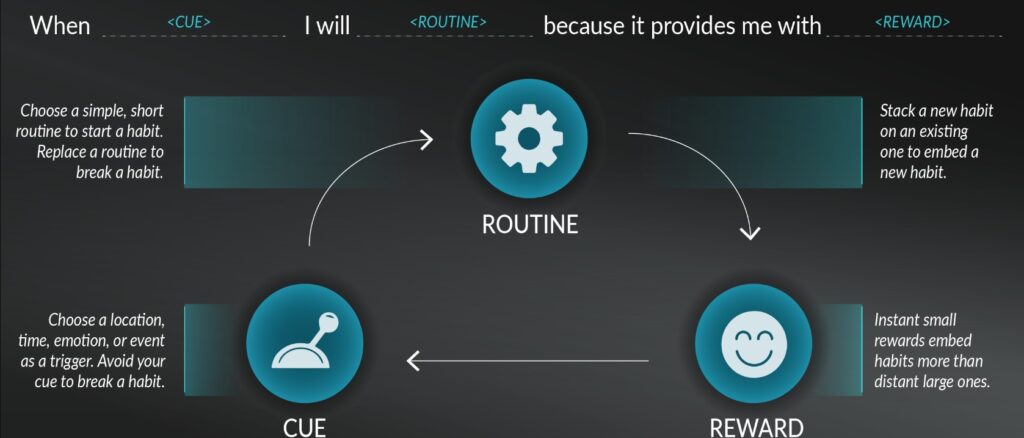
According to researchers like Charles Duhigg (The Power of Habit), habits form in a 3-step loop:
-
Cue (Trigger): Something that tells your brain to start the behavior.
→ Example: Feeling stressed. -
Routine (Action): The behavior itself.
→ Example: Eating junk food. -
Reward (Benefit): What you get from the behavior.
→ Example: Temporary comfort.
Over time, your brain starts craving the reward when it notices the cue.
3. How Long Does It Take to Form a Habit?
-
Popular Myth: 21 days.
-
Reality: Research shows it can take 18 to 254 days, with the average around 66 days.
It depends on the complexity of the habit and your environment.
4. Types of Habits
-
Good habits (positive impact):
Exercise, journaling, saving money, gratitude practice. -
Bad habits (negative impact):
Procrastination, smoking, excessive screen time.
5. How to Build Good Habits (Step-by-Step)
Here’s a simple, powerful strategy:
-
Start tiny: Make it so easy you can’t say no (e.g., 1 push-up, 1-minute meditation).
-
Anchor it: Attach your new habit to an existing habit (e.g., after brushing teeth, meditate).
-
Reward yourself: Celebrate even small wins.
-
Make it obvious: Keep things visible (e.g., leave workout clothes ready).
-
Make it easy: Remove barriers (e.g., prep meals beforehand).
-
Stay consistent: Repetition is key — even imperfect repetition.
6. How to Break Bad Habits
-
Identify the cue: What triggers it?
-
Change the routine: Replace it with a healthier behavior.
-
Make it difficult: Add friction (e.g., delete apps, hide snacks).
-
Get support: Accountability buddies help.
-
Be patient: Slips are normal — it’s about progress, not perfection.
7. Popular Books on Habits
-
Atomic Habits by James Clear (simple, powerful strategies)
-
The Power of Habit by Charles Duhigg (science behind habits)
-
Tiny Habits by BJ Fogg (start small to go big)
8. Cool Facts About Habits
-
40–50% of your daily actions are habitual.
-
Environment beats willpower: Set your space up for success.
-
Identity change is crucial:
E.g., not “I want to run” but “I am a runner.”
9. Common Mistakes When Building Habits
-
Trying to do too much at once.
-
Being perfectionistic (missing one day ≠ failure).
-
Relying only on motivation (discipline + system > motivation).
10. Examples of Great Daily Habits
| Habit | Why it’s powerful |
|---|---|
| Morning walk | Boosts mood and energy |
| Reading 10 pages/day | Grows knowledge |
| Planning tomorrow | Reduces stress |
| 10-min mindfulness | Improves focus and calm |
| Gratitude journaling | Shifts mindset to positive |